
Tag: bank nifty

  • Top 4 High-Probability Intraday Trading Setups for Indian Retail Traders in 2026

    Top 4 High-Probability Intraday Trading Setups for Indian Retail Traders in 2026

    High-probability intraday trading setups are rule-based patterns where price, volume, and market structure come together to offer a statistical edge over many trades. These setups do not guarantee profits; instead, they give you repeatable conditions where the odds tilt in your favour if you respect risk management.

    High-probability intraday trading setups India 2026 are especially useful for Indian retail traders trading Nifty, Bank Nifty, and liquid stocks because they reduce emotional, impulsive entries and force you to wait for clear confirmation.

    Market Context for Intraday Traders in 2026

    The Indian market in 2026 continues to show phases of strong trends followed by sharp corrections driven by macro events like the Union Budget, RBI policy decisions, and global data. Mid- and small-cap segments, along with SME IPOs, remain active, creating both opportunities and risk for intraday traders chasing momentum.

    With increased retail participation and algo activity, intraday moves have become faster, which makes having predefined setups and strict stop-losses absolutely essential.

    Setup 1: Opening Range Breakout (ORB) on Index Futures

    The Opening Range Breakout focuses on the price range formed during the first 15–30 minutes after market open in Nifty, Bank Nifty, or index futures. You mark the high and low of this opening range and take trades only when price breaks out with supporting volume and market breadth in the same direction.

    Basic rules:

    • Time window: 9:15–9:30 or 9:15–9:45 for defining the range
    • Buy above the opening range high with a stop-loss just below the range midpoint or low
    • Sell below the opening range low with a stop-loss just above the range midpoint or high
    • Avoid trades if there is a major event (Budget, RBI policy) scheduled within the same session

    Example: On a trending day after positive macro news, a strong gap-up followed by consolidation in the first 30 minutes can provide a clean upside ORB entry once the high is broken with rising volume.Setup 2: Pullback to 20 EMA in Strong Trend

    The 20-period Exponential Moving Average (EMA) is a popular dynamic support and resistance level on 5–15 minute charts. In a strong uptrend, price often pulls back to the 20 EMA before resuming the move, offering low-risk entries for intraday traders; in a strong downtrend, the 20 EMA acts as resistance.

    Basic rules:

    • Identify strong trend: Higher highs and higher lows for uptrend, lower highs and lower lows for downtrend
    • Enter near 20 EMA when a reversal candle (pin bar, bullish engulfing in uptrend; bearish in downtrend) forms with supportive volume
    • Place stop-loss slightly below the swing low (uptrend) or above the swing high (downtrend)
    • Target 1:1.5 or 1:2 risk–reward, or next intraday support/resistance

    This setup is powerful on trending days following major macro triggers such as RBI announcements or strong global cues, when the market respects moving averages well.

    Setup 2: Break of Previous Day High/Low with Volume

    Price breaking the previous day’s high or low attracts institutional activity, especially in index heavyweights and liquid F&O stocks. When this break happens with strong volume and broader market support, it can lead to a one-directional intraday move.

    Basic rules:

    • Mark previous day high (PDH) and previous day low (PDL) on your chart before the open
    • Go long only when price breaks and sustains above PDH with higher-than-average volume and positive index/sector trend
    • Go short only when price breaks and sustains below PDL with higher volume and weak index/sector trend
    • Avoid trades against the broader index direction or near major news events

    This setup works well when markets are trending over multiple days, often around result seasons or major macro data.Setup 4: VWAP Bounce and Rejection Strategy

    Volume Weighted Average Price (VWAP) represents the average price traded during the day adjusted for volume, and many institutional participants use it as a benchmark. When price approaches VWAP and reacts sharply, it can signal whether smart money is accumulating or distributing.

    Basic rules:

    • In an uptrend day, look for price to pull back to VWAP and show a bullish rejection candle with volume
    • In a downtrend day, look for price to retest VWAP from below and form a bearish rejection candle
    • Enter in the direction of the trend with stop-loss just beyond VWAP
    • Avoid trading when price chops around VWAP with no clear trend (sideways day)

    VWAP-based setups are very effective on days following strong news when institutions gradually build or unwind positions intraday.

    Setup 3: Intraday Breakout in SME/IPO Stocks (With Strict Risk Rules)

    The SME and IPO segment in India has seen high activity with several issues listing in 2025–2026, attracting retail traders for quick intraday gains. However, these stocks can be extremely volatile and illiquid, so a structured breakout approach with small position sizing is crucial.

    Basic rules:

    • Trade only highly liquid IPOs/SMEs with good listing volumes and clean intraday chart structure
    • Identify a clear consolidation or flag pattern after listing or early in the day and enter only on breakout with volume spike
    • Use strict stop-loss (for example 1–2 percent) and smaller capital allocation compared to index or large-cap trades
    • Avoid chasing vertical moves after multiple green candles; wait for consolidation

    This setup is best treated as an opportunistic add-on, not your primary bread-and-butter system, because gap risk and slippage can be high.Setup 6: News and Event-Based Trades (Budget, RBI Policy, Results)

    Macro events like the Union Budget, RBI Monetary Policy, inflation data, and corporate results often create short-term volatility spikes in indices and sectoral stocks. If handled with rules, event-based trades can offer strong intraday moves; if handled emotionally, they can also lead to rapid losses.

    Basic rules:

    • Avoid taking large positions just before the event announcement because spreads can widen and whipsaws are common
    • Wait for the first 5–15 minutes after the event to see the initial directional reaction
    • Enter only when price breaks a key intraday level (opening range, PDH/PDL, or VWAP) in line with the post-event direction
    • Reduce position size and accept that slippage can be higher than usual

    Examples: Union Budget days, RBI rate decisions, and major result announcements in banking, auto, or IT can provide strong intraday swings.

    Setup 4: Mean-Reversion in Range-Bound Markets

    Not every day is a trending day; many sessions remain range-bound with the index oscillating between support and resistance. On such days, mean-reversion setups—buying near support and selling near resistance with clear confirmation—can work better than breakout strategies.

    Basic rules:

    • Identify a clean intraday range where price has tested support and resistance multiple times
    • Buy near support only when a rejection candle or bullish pattern forms with stabilising volume; place stop-loss just below support
    • Sell near resistance only when a bearish rejection pattern forms with weakening volume or failed breakout
    • Do not try mean-reversion on strong trending days after big news; you will end up fighting momentum

    Mean-reversion setups are ideal for days when economic calendars are light and there are no major data releases lined up.Risk Management Rules for All Setups

    Regardless of how strong a setup looks, risk management is what keeps you in the game long enough for your edge to play out. Many new traders focus only on entries and ignore position sizing, maximum daily loss limits, and diversification across instruments.

    Core rules you can follow:

    • Risk per trade: 0.5–1 percent of capital for beginners
    • Maximum daily loss: Stop trading for the day after 2–3 losing trades or a total of about 2–3 percent drawdown
    • Use hard stop-loss orders instead of mental stop-losses, especially during event days
    • Maintain a trading journal with screenshots of setups, rationale, and post-trade review

    When you combine high-probability setups with disciplined risk management, even a modest win rate can yield consistent growth over time.

    Trading Psychology for Retail Intraday Traders

    Intraday trading psychology is often more important than the strategy itself because fear and greed can make you break your own rules. Overtrading, revenge trading after a loss, and FOMO during sharp moves are some of the most common behavioural traps Indian retail traders fall into.

    Simple psychological rules:

    • Commit to following only 1–3 setups at a time instead of chasing everything
    • Trade with predefined plans including entry, stop-loss, and target before you click buy or sell
    • Accept that missing a move is better than forcing a bad trade against your rules
    • Review your emotional state daily and reduce size or stop trading when you feel triggered or fatigued

    Working on psychology is continuous, but it can be the one change that turns a breakeven trader into a consistently profitable one.How to Practically Implement These Setups with a Trading Journal

    To make these intraday trading setups India 2026 truly work for you, you must test them on your own charts, instruments, and timeframes. Start with paper trading or small capital and record at least 30–50 trades per setup before deciding whether it suits your style.

    Suggested implementation steps:

    • Pick 2–3 setups (for example ORB, 20 EMA pullback, VWAP bounce) and focus only on them for one to three months
    • Use a structured journal (spreadsheet or notebook) to record date, instrument, setup type, entry, stop, target, result, and notes
    • Review weekly to see which setups work best for you in current market conditions and which ones need adjustments or should be dropped
    • Gradually scale position size only when you see stability in execution and risk control, not just when you have a lucky winning streak

    By combining high-probability intraday trading setups India 2026, strict risk management, and honest journaling, Indian retail traders can build a professional approach aligned with the educational vision of Learn Share Market.

    Disclaimer: Trading in derivatives involves high risk. This post is for educational purposes only. Always consult a SEBI-registered advisor before making investment decisions.
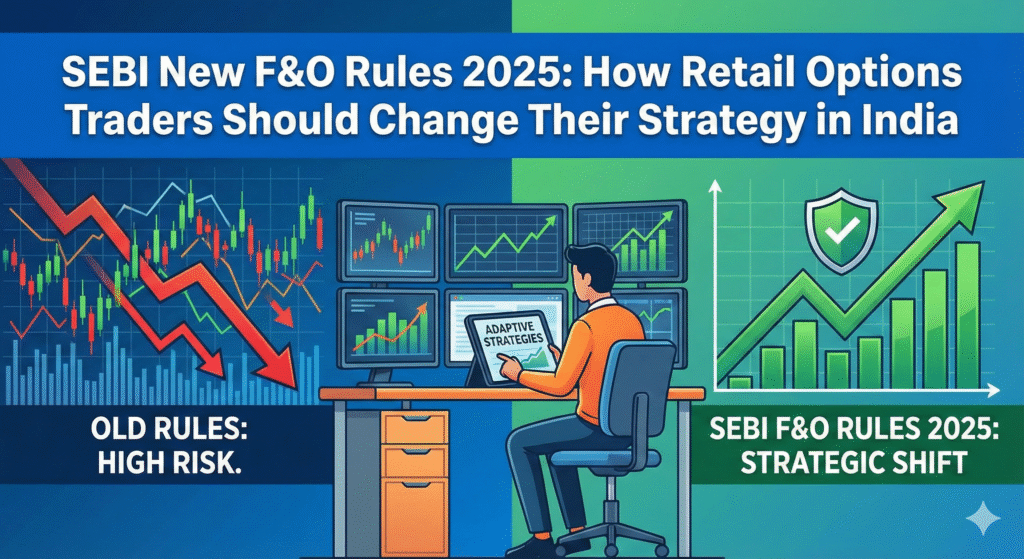
  • SEBI’s New F&O Rules (Dec 2025): Final Deadline & Your 2026 Strategy

    1. The December 2025 Hard Deadline: What’s New?

    The most critical change this December is the removal of the ‘Next Day Compliance’ buffer. Previously, traders had a one-day grace period to adjust their positions if they breached Market Wide Position Limits (MWPL) or personal delta limits.

    Key updates effective now:

    Delta Limits: Gross long and short delta limits are strictly capped, impacting liquidity and large-scale options selling strategies.

    As of December 2025, the Indian derivatives market has entered its most significant regulatory phase yet. With SEBI’s final glide path for index options ending on December 6, 2025, retail traders are now operating under a “Hard Limit” regime. This means no more grace periods for excess delta positions and stricter intraday monitoring that could trigger immediate margin calls.

    Zero Grace Period: Positions must be compliant by the end of the same trading day.

    Enhanced Intraday Monitoring: Exchanges are now conducting multiple random snapshots to check for exposure violations.

    If you are an options trader in India, your strategy for 2026 cannot be the same as it was in 2024. In this post, we break down exactly what has changed this month and how you should adapt your trading plan to stay profitable and compliant in the new year.

    2. Strategy Shifts for 2026

    In this new environment, retail traders must shift from pure speculation to risk-managed setups.

    What you should do now:

    • Shift to Defined-Risk Spreads: Instead of naked option selling, use Bull Call Spreads, Bear Put Spreads, or Iron Condors. These have capped losses and often better margin treatment under the new rules.
    • Maintain a Cash Buffer: Since intraday monitoring is random, keeping a 15-20% cash buffer in your trading account is no longer optional—it’s a necessity to avoid auto-liquidation.
    • Focus on Liquid Indices: Stick to Nifty 50 and Bank Nifty where bid-ask spreads are tight and liquidity is high enough to handle sudden volatility.

    3. Commodity Outlook: Copper and Natural Gas

    As we look toward 2026, commodities like Copper and Natural Gas are showing strong technical patterns. Industrial demand for copper remains a key theme for the new year. Traders should watch for breakouts on the MCX and align their positions with global inventory reports.

    Final Thoughts

    December 2025 is a turning point for the Indian stock market. While the new SEBI rules might seem restrictive, they are designed to bring maturity to the derivatives segment. By adapting your strategy early and focusing on risk management, you can navigate these changes successfully.

    What are your thoughts on the new F&O limits? Let us know in the comments below!

    Disclaimer: Trading in derivatives involves high risk. This post is for educational purposes only. Always consult a SEBI-registered advisor before making investment decisions.

  • Best Intraday Trading Strategies for Indian Retail Traders in 2025 (With Practical Examples)

    Intraday trading in India has exploded in 2024-2025, with retail participation at an all-time high. The stock market volatility, lower brokerage costs, and accessibility of trading platforms have made day trading more attractive than ever. However, without proven strategies and disciplined execution, most traders lose money. This guide covers the best intraday trading strategies specifically designed for Indian retail traders, complete with practical examples and risk management rules.

    Why Intraday Trading is Booming in 2025

    The Indian intraday trading market has grown significantly due to several factors:

    • Increased Retail Participation: More Indians now trade actively through mobile apps and funded accounts.
    • Lower Brokerage Costs: Flat fees and zero-brokerage models have reduced transaction costs dramatically.
    • Market Volatility: Economic changes, geopolitical events, and FII activity create daily price movements, presenting day trading opportunities.
    • Better Technology: Real-time charting tools, scanners, and AI-powered alerts have made analysis more accessible.

    However, this growth comes with a warning: Over 90% of retail day traders lose money. The difference between winners and losers is not luck—it’s a proven strategy, disciplined execution, and strict risk management.

    What Makes a Winning Intraday Strategy?

    Before diving into specific strategies, let’s understand the characteristics of a high-probability intraday strategy:

    1. Liquidity: Trade only highly liquid instruments—large-cap stocks, index futures (Nifty, Bank Nifty), and ETFs.
    2. Clear Entry and Exit Rules: Ambiguity leads to emotional trading and losses.
    3. Tight Risk-Reward Ratio: Aim for at least 1:2 risk-reward on every trade (risk 1% to make 2%).
    4. Backtested and Paper Traded: Never trade live without proving the strategy works first.
    5. Position Sizing: Never risk more than 1-2% of your capital per trade.

    Best Intraday Trading Indicators for Indian Markets

    These indicators work best on 5-minute, 15-minute, and 1-hour charts:

    1. Volume Weighted Average Price (VWAP)

    VWAP shows the average price at which institutional investors are trading. Intraday reversals often happen at VWAP levels. On high-volume breakouts, price respecting VWAP is a strong bullish or bearish signal.

    2. Exponential Moving Averages (EMA)

    Use 9-period and 20-period EMAs on 5-minute charts. When the 9 EMA is above the 20 EMA, the trend is up. Pullbacks to the 9 EMA are ideal buy zones in an uptrend.

    3. Relative Strength Index (RSI)

    RSI above 70 indicates overbought conditions, and below 30 indicates oversold conditions. However, in strong intraday trends, RSI can remain overbought or oversold for extended periods. Use RSI for divergence trading rather than absolute levels.

    4. Volume

    Volume confirms breakouts. A price breakout on low volume is likely to fail. True breakouts always come with increased volume.

    Strategy 1: Opening Range Breakout (ORB) for Nifty and Bank Nifty

    The Opening Range Breakout strategy is one of the most popular intraday trading strategies in India, especially for index futures.

    How It Works:

    1. Time Frame: First 15-30 minutes of market open (9:15 AM to 9:45 AM IST).
    2. Mark the Range: Note the high and low of the first 15-30 minutes.
    3. Calculate Mid-Point: (High + Low) / 2
    4. Entry Rules:
    • Long Entry: When price breaks above the range high with confirmed volume. Stop loss: 10-15 pips below the mid-point.
    • Short Entry: When price breaks below the range low. Stop loss: 10-15 pips above the mid-point.
    1. Profit Target: 1.5 to 2.5 times the risk taken (e.g., if you risk 15 pips, target 30-40 pips).

    Example:

    Suppose Bank Nifty opens with the following range in the first 30 minutes:

    • High: 52,200
    • Low: 52,000
    • Mid-point: 52,100

    Long Setup: If Bank Nifty breaks above 52,200 on volume, enter at 52,220. Stop loss at 52,085 (risk: 135 points). Target: 52,350 (reward: 130 points). Risk-reward is approximately 1:0.96 (not ideal but acceptable if the strategy hits 60%+ winning trades).

    Short Setup: If Bank Nifty breaks below 52,000 on volume, enter at 51,980. Stop loss at 52,115 (risk: 135 points). Target: 51,850 (reward: 130 points).

    Key Points:

    • This strategy works best on volatile days.
    • On range-bound days, multiple false breakouts can lead to losses.
    • Avoid trading if major economic news (RBI policy, US Fed announcement) is expected within 1-2 hours.

    Strategy 2: VWAP Pullback Strategy for Liquid Large-Caps

    This strategy works well on highly liquid stocks like SBI, HDFC Bank, TCS, Infosys, and Reliance, which have high intraday volume and minimal spreads.

    How It Works:

    1. Identify the Trend: Check the 15-minute or 1-hour chart. Is the stock moving in an uptrend or downtrend?
    2. Find VWAP: Plot VWAP on your 5-minute chart.
    3. Wait for a Pullback: After a strong intraday move, wait for price to pullback near VWAP with volume drying up.
    4. Entry: When price approaches VWAP from above (in an uptrend), enter on reversal candles (Doji, Hammer) on high volume. Stop loss: 2-3% below VWAP.
    5. Profit Target: Exit at 1:1 risk-reward or trail the stop using the 9 EMA.

    Example:

    Suppose TCS is in an intraday uptrend on the 15-minute chart:

    • Trend high: 3,520
    • Pullback to VWAP: 3,480
    • Current price: 3,485

    Entry: Buy at 3,490 (on reversal candle confirmation). Stop loss: 3,460 (risk: 30 points). Target: 3,520 (reward: 30 points).

    Key Points:

    • This strategy has a high win rate (60-70%) because it trades in the direction of the trend.
    • It works best when the trend is clean and strong.
    • On choppy, sideways days, pullbacks can be fake, leading to losses.

    Strategy 3: Breakout + Retest Strategy on 5-Minute Charts

    This strategy takes advantage of the fact that traders often chase breakouts, and the initial move is usually too fast. The retest offers a better risk-reward entry.

    How It Works:

    1. Identify Key Levels: Mark intraday support and resistance on 5-minute or 15-minute charts.
    2. Wait for Breakout: Wait for price to break above resistance or below support on high volume.
    3. First Pullback: Instead of entering at the breakout, wait for price to retest the broken level (now acting as support for upside breakouts).
    4. Entry on Retest: Enter when price reverses from the retest on volume. Stop loss: Just below the retest low (for long breakout).
    5. Target: 1.5-2x the risk taken.

    Example:

    Suppose Infosys on a 5-minute chart has:

    • Resistance at 1,950
    • Price breaks above 1,950 to 1,965 on high volume
    • Price then retests 1,950 to 1,955 with lower volume

    Entry: Buy at 1,957 (on reversal from retest). Stop loss: 1,945 (risk: 12 points). Target: 1,975 (reward: 18 points). Risk-reward: 1:1.5, which is acceptable.

    Key Points:

    • This strategy has a higher win rate than chasing breakouts.
    • It reduces false breakout risks.
    • It works best on volatile, high-volume trading days.

    Risk Management Rules for Indian Intraday Traders

    No strategy works if risk is not managed properly. Follow these rules strictly:

    1. Fixed Daily Loss Limit

    Set a maximum daily loss of 2-3% of your trading capital. Once you hit this limit, stop trading for the day. If you start with ₹1,00,000, your max daily loss should be ₹2,000 to ₹3,000.

    2. Position Sizing

    Risk only 1-2% per trade. If a trade requires a 30-point stop loss and each point is worth ₹100 in Bank Nifty, the risk is ₹3,000. With ₹1,00,000 capital, this is 3% risk—too high. Reduce the position size.

    3. Always Use Stop Losses

    Never trade without a predetermined stop loss. Averaging down in intraday trading is extremely dangerous because intraday moves can be severe.

    4. Margin Management

    Be cautious with leverage. Just because your broker allows you to trade with 5x margin doesn’t mean you should. Over-leverage amplifies losses quickly.

    5. Maximum Trades Per Day

    Limit yourself to 5-8 trades per day. Over-trading leads to emotional decisions and losses.

    6. Avoid News Events

    Don’t trade in the 30 minutes before or after major news events (RBI policy, US Fed decisions, election results, corporate earnings). These events cause extreme volatility and gap moves that stop losses can’t protect against.

    Common Intraday Trading Mistakes to Avoid

    1. Revenge Trading

    After a loss, many traders take bigger risks to recover losses quickly. This leads to larger losses. Stick to your position sizing.

    2. Trading Illiquid Stocks

    Small-cap stocks and penny stocks have wide bid-ask spreads. You’ll lose money to spread costs alone before the trade works.

    3. No Trading Plan

    Entering trades based on “feeling” or tips leads to emotional trading and losses. Every trade must have a planned entry, exit, and stop loss.

    4. Ignoring Trend Direction

    Trading against the primary trend is counterintuitive. If Nifty is down 200 points, avoid buying individual stocks on weakness unless there’s a specific technical setup.

    5. Switching Strategies

    Traders often abandon a strategy after 2-3 losses and switch to something else. Strategies need 50+ trades to prove themselves. Give each strategy at least a month of trading.

    6. Trading During Low Volume Hours

    Intraday volume is highest from 9:15 AM to 11 AM IST and lowest from 12:30 PM to 2:30 PM. Trade during high-volume periods for better execution.

    How to Practice and Master These Strategies

    Step 1: Backtest

    Before trading live, backtest each strategy on 50-100 historical trades using free tools like TradingView or Zerodha’s backtest feature. Track the win rate, average win, and average loss.

    Step 2: Paper Trade

    Once backtesting shows a positive expectancy (average win × win rate > average loss × loss rate), paper trade for 1-2 weeks. Execute the exact same way you would with real money.

    Step 3: Live Trading (Small Size)

    Start with the smallest position size possible. Trade live for 2-4 weeks with real money but minimal capital at risk. This builds experience and psychological resilience.

    Step 4: Scale Up Gradually

    Once you’re consistently profitable on small size, gradually increase position size. Never double your position size after a winning week.

    Final Thoughts: The Key to Intraday Success

    The best intraday trading strategies for Indian retail traders share common traits: they’re simple, they’re based on price action and volume, and they prioritize risk management over big profits. Trading is a long-term game. Strategies that have a 55-60% win rate and a 1:1.5 risk-reward ratio will make you money over time if you follow them consistently.

    Remember: The goal is not to find the “perfect” strategy—it’s to find a strategy that works for you and execute it with discipline. Start small, backtest thoroughly, and scale gradually. Most importantly, respect your stop losses and never risk more than you can afford to lose.

    Start your intraday trading journey today with proven strategies and proper risk management. The Indian stock market is full of opportunities for disciplined traders who follow a systematic approach.

    Disclaimer: This article is for educational purposes only and does not constitute financial advice. Always consult with a SEBI-registered investment advisor before trading. Past performance does not guarantee future results. Intraday trading carries significant risk of capital loss.