Tag: financial education

  • SEBI’s New F&O and Intraday Margin Rules 2025–26: Complete Guide for Retail Traders

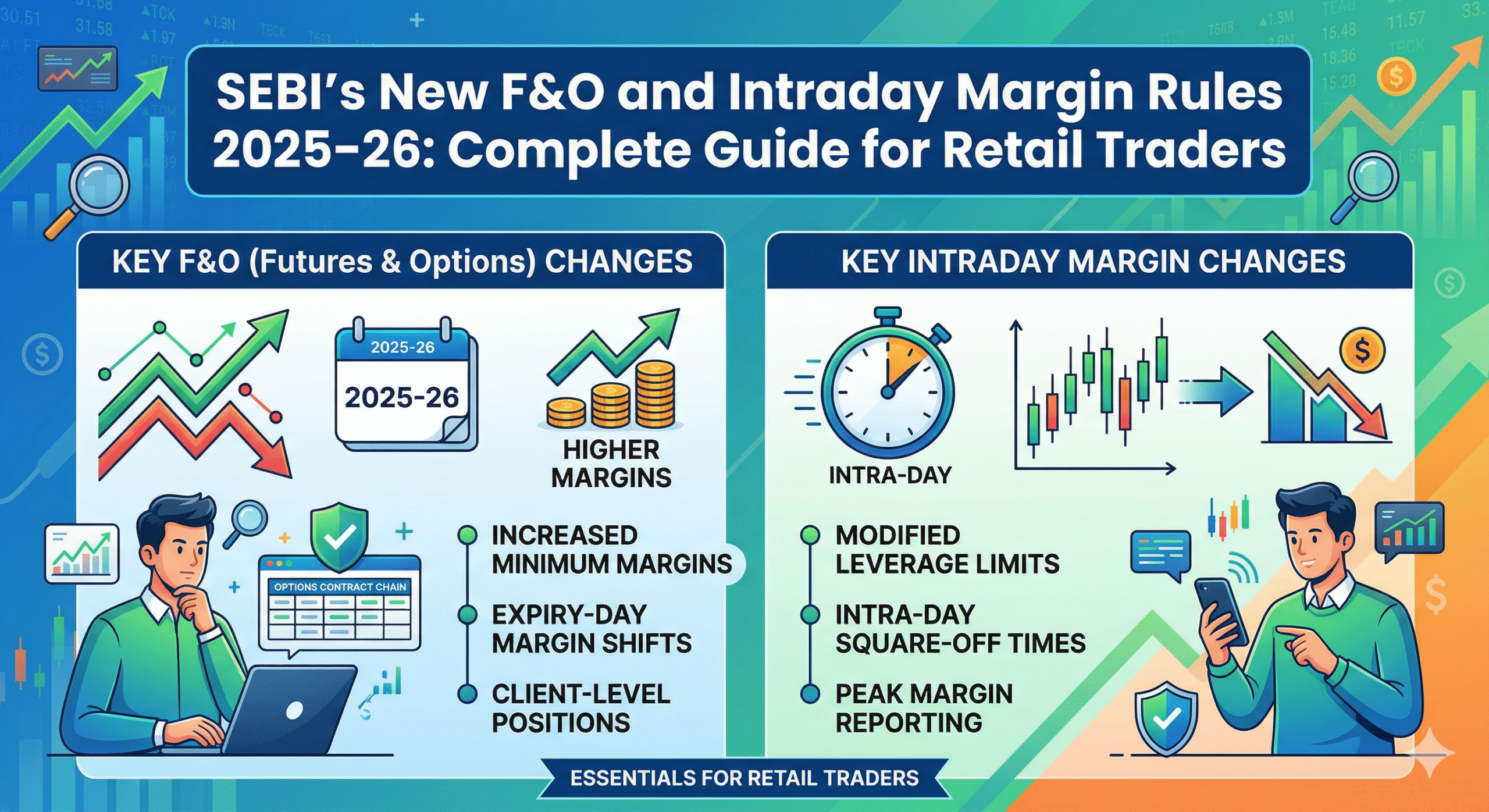
    SEBI’s New F&O and Intraday Margin Rules 2025–26: Complete Guide for Retail Traders

    If you trade intraday or in F&O, SEBI’s new rules in 2025–26 are silently changing your P&L whether you realise it or not. The era of extreme high leverage, ultra‑low margin and aggressive expiry‑day gambling is ending, and every retail trader needs to understand this shift clearly.

    In this article, we will break down the new rules in simple language with practical trading examples, and then see how you should adjust your intraday and F&O trading style accordingly.

    Why Did SEBI Change the Rules? – Background for Retail Traders

    Over the last few years, SEBI’s data has shown that around 89–93% of individual F&O traders were losing money, and losing it very fast. Most of the damage was due to very high leverage, lack of proper risk management, and a “quick money” mindset.

    The regulator had two main objectives:

    • Protect retail traders from uncontrolled leverage
    • Make the F&O market more stable and risk‑controlled

    That is why margins, leverage, weekly expiry structure and lot sizes have all been tightened over time.

    Intraday Margin Rules 2025–26 – How Much Margin and Leverage Now?

    For intraday traders, the biggest visible change is in margin rules.

    1. 20% Minimum Upfront Margin – Explained

    In the equity cash segment, you now need to pay a minimum of 20% upfront margin to take an intraday trade.

    • Example: If you want to take an intraday buy trade worth 1,00,000, you must keep at least 20,000 as margin with your broker.
    • This is calculated using the VaR + ELM framework, and brokers must collect this margin latest by T+1.

    In simple terms, the old style of “30–40X leverage in random small‑cap stocks with tiny capital” is practically over.

    2. Why You Don’t Get More Than Around 5X Leverage Now

    Under SEBI’s new margin framework, brokers can give only limited intraday leverage, usually up to about 5X.

    • Earlier, some brokers used to offer 20X–40X intraday leverage, allowing huge positions with very small capital.
    • Now, if a broker goes beyond the framework, they face penalties and compliance issues.

    Result: either you increase your trading capital or you reduce your position size to match the new reality.

    New F&O Rules 2025 – What Changed for Option Buyers and Sellers?

    SEBI has also brought strong changes in the F&O segment from 2025 onwards.

    1. Full Premium Upfront – No Extra Leverage for Option Buyers

    Option buyers now have to pay the full premium upfront – there is effectively no extra leverage for buying options.

    • Example: If a call option is trading at 120 and the lot size is 300, you must pay 120 × 300 = 36,000 in full; you cannot enter with a tiny margin.

    This reduces gambling‑style option buying, but for serious traders it creates a clean, defined‑risk structure where your maximum loss is clear from the start.

    2. Weekly Expiries, Lot Sizes and Expiry‑Day Margins

    The new framework also focuses on rationalising weekly expiries, adjusting lot sizes in some indices, and increasing margin requirements on expiry‑day, especially for option sellers.

    • On expiry‑day, extra margins such as an additional Extreme Loss Margin can apply, making naked short‑straddles and high‑leverage expiry games significantly riskier.

    From a trading perspective, expiry‑day aggressive option selling without strong risk control and capital buffer is no longer a smart move.

    Real Impact on Small Retail Traders

    1. Is High‑Leverage Scalping Now Much Harder?

    Traders who were relying on high leverage with small capital to build large intraday positions will feel the pain first.

    • To generate the same rupee profit, you now either need more capital or lower expectations.
    • Over‑trading, revenge trading and random stock picking will hurt faster, because the “safety cushion” of huge leverage has been removed.

    However, from a long‑term viewpoint, these rules protect traders who were trading purely on tips and emotions with no risk framework.

    2. How Should You Change Capital Management and Position Sizing?

    The game has shifted from “small capital + huge lot size” to “adequate capital + controlled lot size + fixed risk per trade”.

    • Ideally, you should not risk more than 1–2% of total capital on any single trade.
    • It is better to think in fixed rupee risk – for example, “I will not lose more than 1,000–2,000 per trade”, and then calculate quantity from that.

    This mindset helps you survive in the market for years, instead of blowing up the account in a few months.

    Practical Trading Tips – How to Trade After SEBI’s New Rules?

    1. Framework for Intraday Equity Traders

    • Take fewer but higher‑quality trades: Focus only on setups where trend, volume and levels are clear; avoid random 10–15 trades a day.
    • Pre‑define stop‑loss and targets: Mark your levels on the chart before entering and avoid emotional exits.
    • Stick to liquid largecaps and indices: In illiquid, low‑volume stocks, the earlier leverage advantage is gone; it is better to focus on Nifty 50 names and liquid midcaps.

    2. Option Strategies That Work Better With Higher Margins

    Naked option selling has become expensive and risky, but you can still use smarter, defined‑risk strategies:

    • Debit spreads (Bull Call or Bear Put): Limited loss, relatively lower capital; very suitable for beginners.
    • Defined‑risk credit spreads: Replace naked shorts with hedged spreads; your margin and risk both remain under control.
    • Positional swings instead of pure event gambling: Prefer 3–10 day swing setups over pure result‑day or news‑day lottery trades.

    Since you already work deeply with technicals and futures data, these strategies are natural extensions you can also showcase with real chart examples on your site.

    FAQs – Most Common Questions in 2026

    Q1: Is it now impossible to earn consistent income from intraday trading?
    No. It is not a high‑leverage game anymore; it is a skill + discipline game. You will need slightly more capital and much better risk control, but steady growth is still possible.

    Q2: Should small‑capital traders quit the market now?
    Not at all. They just need to reset expectations – smaller targets, slower compounding, and more focus on learning and process instead of quick profits.

    Q3: Is options trading now only for big‑capital traders?
    Big capital definitely has an edge, but small traders can still participate using defined‑risk spreads, smaller‑lot indices, and a learning‑first approach, while staying away from gambling‑style naked positions.

    Final Note

    SEBI’s new F&O and intraday margin rules for 2025–26 have made the market tougher but also clearer – the message is simple: survive long, don’t gamble short. Traders who take risk, capital and psychology seriously will be the ones still standing – and compounding – in the coming years.


  • How to Analyze Nifty 50 Stocks for Futures Trading: A Step-by-Step Educational Guide

    How to Analyze Nifty 50 Stocks for Futures Trading: A Step-by-Step Educational Guide

    Futures trading in Nifty 50 stocks offers lucrative opportunities for informed investors, but success requires a systematic approach to stock analysis. This comprehensive guide walks you through the essential steps to analyze Nifty 50 stocks for futures trading, helping you make educated investment decisions.

    Understanding Nifty 50 Futures Trading

    The Nifty 50 index represents India’s top 50 companies by market capitalization. Futures trading on these stocks allows investors to speculate on price movements without owning the underlying assets. However, proper analysis is crucial for success.

    Step 1: Fundamental Analysis Framework

    Financial Health Assessment

    • Revenue Growth: Examine quarterly and annual revenue trends
    • Profit Margins: Analyze gross, operating, and net profit margins
    • Debt-to-Equity Ratio: Assess financial leverage and risk
    • Return on Equity (ROE): Measure management efficiency
    • Price-to-Earnings (P/E) Ratio: Evaluate valuation metrics

    Industry Position Analysis

    • Market share within the sector
    • Competitive advantages and moats
    • Regulatory environment impact
    • Growth prospects and market trends

    Step 2: Technical Analysis Techniques

    Chart Pattern Recognition

    • Support and Resistance Levels: Identify key price levels
    • Trend Lines: Determine market direction
    • Moving Averages: Use 20, 50, and 200-day moving averages
    • Volume Analysis: Confirm price movements with volume

    Key Technical Indicators

    • Relative Strength Index (RSI): Measure momentum
    • MACD: Identify trend changes
    • Bollinger Bands: Assess volatility
    • Fibonacci Retracements: Find potential reversal levels

    Step 3: Risk Assessment and Position Sizing

    Risk Management Principles

    • Never risk more than 2-3% of your capital on a single trade
    • Set stop-loss levels before entering positions
    • Calculate risk-reward ratios (aim for minimum 1:2)
    • Diversify across different sectors within Nifty 50

    Position Sizing Formula

    Position Size = (Account Risk / Trade Risk) × Account Balance

    Example: If you have ₹1,00,000 and risk 2% (₹2,000) with a stop-loss creating ₹500 risk per lot, you can trade 4 lots maximum.

    Step 4: Market Sentiment Analysis

    Economic Indicators to Monitor

    • GDP growth rates
    • Inflation data (CPI, WPI)
    • Interest rate decisions by RBI
    • Foreign institutional investor (FII) flows
    • Currency fluctuations (USD/INR)

    News and Events Impact

    • Quarterly earnings announcements
    • Management guidance changes
    • Regulatory updates
    • Geopolitical developments

    Step 5: Timing Your Trades

    Market Hours Strategy

    • 9:15-10:00 AM: High volatility opening hour
    • 2:00-3:30 PM: Afternoon consolidation period
    • Avoid 11:30 AM-2:00 PM: Lunch hour low activity

    Expiry Week Considerations

    • Increased volatility in the last week of monthly expiry
    • Time decay acceleration for option positions
    • Higher margins and risk during expiry week

    Step 6: Building Your Analysis Checklist

    Pre-Trade Checklist

    • [ ] Fundamental analysis completed
    • [ ] Technical setup confirmed
    • [ ] Risk management plan in place
    • [ ] Market sentiment assessed
    • [ ] Entry and exit points defined
    • [ ] Stop-loss and target levels set

    During Trade Management

    • Monitor price action against key levels
    • Adjust stop-loss as trade moves favorably
    • Stay updated with relevant news
    • Avoid emotional decision-making

    Common Mistakes to Avoid

    1. Over-leveraging: Using excessive margin
    2. Ignoring risk management: Trading without stop-losses
    3. Following tips blindly: Not conducting personal analysis
    4. Emotional trading: Letting fear and greed drive decisions
    5. Inadequate research: Insufficient fundamental and technical analysis

    Educational Resources for Continued Learning

    Recommended Tools

    • Trading Platforms: Zerodha Kite, Upstox, Angel Broking
    • Analysis Software: TradingView, ChartInk
    • News Sources: Economic Times, Moneycontrol, Bloomberg Quint
    • Educational Websites: NSE India, BSE India learning modules

    Books for Further Reading

    • “Technical Analysis of the Financial Markets” by John J. Murphy
    • “The Intelligent Investor” by Benjamin Graham
    • “Options as a Strategic Investment” by Lawrence G. McMillan

    Conclusion

    Successful Nifty 50 futures trading requires a disciplined approach combining fundamental analysis, technical analysis, risk management, and market sentiment assessment. Remember that consistent profitability comes from following a systematic process rather than seeking quick profits.

    Start with paper trading to practice your analysis skills before risking real capital. Continuously educate yourself about market dynamics and refine your analytical approach based on market feedback.


    Disclaimer

    This content is for educational purposes only and should not be considered as financial advice. Futures trading involves substantial risk and may not be suitable for all investors. Past performance does not guarantee future results. Always consult with a qualified financial advisor before making investment decisions. The author and publisher are not responsible for any losses incurred from trading activities based on this information.

    Risk Warning

    Futures trading can result in the loss of your entire investment. Only trade with money you can afford to lose. Ensure you understand the risks involved and seek independent financial advice if necessary.

    Keywords: Nifty 50 futures trading, stock analysis, technical analysis, fundamental analysis, risk management, futures trading strategy, Indian stock market, NSE futures, trading education, investment guide

  • 5 Golden Rules for Successful Swing Trading in the Indian Stock Market (2025 Edition)

    5 Golden Rules for Successful Swing Trading in the Indian Stock Market (2025 Edition)

    Swing trading continues to be a popular strategy for Indian investors aiming for short-to-medium-term market gains. Whether you’re trading Nifty stocks or mid-caps, mastering swing trading requires discipline and a clear set of rules. Here are five golden rules to boost your success rate in 2025:

    1. Follow Trends, But Don’t Predict Them
      Use trend-following indicators like moving averages and RSI to identify strong moves. Avoid guessing tops and bottoms—go with the momentum.
    2. Set Clear Entry and Exit Targets
      Decide entry/exit levels before placing any trade. Stick to your plan, even if emotions tempt you to act otherwise.
    3. Risk Only a Small Portion per Trade
      Successful swing traders limit risk—never stake more than 1-2% of capital on a single trade. Use stop-loss orders to protect your capital.
    4. Keep a Trading Journal
      Track every trade, even losses. Reviewing your journal will help you refine strategies and avoid repeat mistakes.
    5. Avoid Overtrading
      Quality beats quantity. Don’t chase every opportunity—pick trades with the best risk/reward setups.

    Conclusion:
    Swing trading can be lucrative if you follow a rules-based approach, sustain discipline, and continuously learn. Apply these golden rules to improve your strategy in 2025.

  • Stock Market Basics for Beginners in India – A Simple Introduction

    Investing in the stock market can seem overwhelming, especially for beginners. If you’re new to the world of investing and wondering how the Indian stock market works, you’ve come to the right place. This comprehensive guide will break down everything you need to know about stock market basics in simple, easy-to-understand terms.

    What is a Stock Market?

    A stock market is essentially a marketplace where shares of publicly listed companies are bought and sold. Think of it like a giant auction house where people trade ownership pieces (called shares or stocks) of businesses.

    When you buy a stock, you’re purchasing a small portion of that company. If the company does well, the value of your shares typically increases. If it doesn’t perform well, the value may decrease.

    How Does It Work?

    Companies issue shares to raise money for their business operations and growth. Investors buy these shares hoping that the company will grow and become more valuable over time, making their investment worth more.

    Why Should You Invest in Stocks?

    There are several compelling reasons why investing in stocks can be beneficial:

    1. Beat Inflation

    Over time, inflation reduces the purchasing power of money sitting in savings accounts. Historically, stock market investments have provided returns that outpace inflation.

    2. Wealth Creation

    The power of compounding can help your money grow significantly over long periods. Even small, regular investments can accumulate substantial wealth over 10-20 years.

    3. Additional Income

    Many stocks pay dividends, providing you with regular income in addition to potential capital gains.

    4. Financial Independence

    Building a diversified stock portfolio can help you achieve financial goals like retirement, buying a home, or funding your children’s education.

    Understanding the Indian Stock Market

    India has two primary stock exchanges:

    National Stock Exchange (NSE)

    • Established in 1992
    • India’s largest stock exchange by market capitalization
    • Home to the famous Nifty 50 index
    • Uses electronic trading systems

    Bombay Stock Exchange (BSE)

    • Founded in 1875, making it Asia’s oldest stock exchange
    • Houses the benchmark Sensex index (30 top companies)
    • Located in Mumbai’s Dalal Street

    Key Market Indices

    Sensex (BSE): Tracks the performance of 30 large, well-established companies.

    Nifty 50 (NSE): Represents 50 large-cap companies across various sectors.

    These indices serve as barometers of overall market performance.

    Common Stock Market Myths Debunked

    Myth 1: “Stock Market is Like Gambling”

    Reality: While there’s risk involved, investing based on research and fundamental analysis is very different from gambling. Successful investors study companies, understand business models, and make informed decisions.

    Myth 2: “You Need Lots of Money to Start”

    Reality: You can start investing with as little as ₹100 through Systematic Investment Plans (SIPs) in mutual funds, or buy fractional shares of expensive stocks.

    Myth 3: “Stock Market is Only for Experts”

    Reality: With basic knowledge and discipline, anyone can invest successfully. Many online resources and investment apps have made investing more accessible than ever.

    Myth 4: “Timing the Market is Everything”

    Reality: Research shows that time in the market is more important than timing the market. Consistent, long-term investing typically yields better results than trying to predict market movements.

    3 Action Tips to Get Started

    1. Educate Yourself First

    • Read reputable financial websites and books
    • Understand basic financial terms
    • Learn about different types of investments (stocks, mutual funds, ETFs)
    • Take online courses on investing basics

    Recommended Resources:

    • SEBI investor awareness materials
    • NSE and BSE educational content
    • Financial newspapers like Economic Times

    2. Start Small and Systematic

    • Open a Demat and trading account with a registered broker
    • Begin with SIPs in diversified mutual funds
    • Start with ₹1,000-5,000 per month if possible
    • Gradually increase investments as your income grows

    Popular Investment Options for Beginners:

    • Index funds (Nifty 50, Sensex)
    • Large-cap mutual funds
    • ELSS funds (for tax benefits)

    3. Build a Diversified Portfolio

    • Don’t put all money in one stock or sector
    • Spread investments across different company sizes (large-cap, mid-cap, small-cap)
    • Include different sectors (IT, banking, FMCG, pharma, etc.)
    • Consider international diversification through international funds

    Sample Beginner Portfolio Allocation:

    • 60% Large-cap funds/stocks
    • 20% Mid-cap funds
    • 10% Small-cap funds
    • 10% International funds

    Important Things to Remember

    • Invest only what you can afford to lose: Never invest borrowed money or emergency funds
    • Stay patient: Wealth creation through stocks takes time, typically 5-10 years or more
    • Regular monitoring: Review your portfolio quarterly, but avoid daily tracking
    • Keep learning: Markets evolve, so continuous education is important
    • Avoid emotional decisions: Don’t panic during market downturns or get greedy during bull runs

    Getting Started Checklist

    ✓ Complete KYC (Know Your Customer) process
    ✓ Open Demat and trading accounts
    ✓ Link bank account for transactions
    ✓ Download broker’s mobile app
    ✓ Start with small amounts
    ✓ Set up systematic investment plans
    ✓ Keep track of your investments

    Conclusion

    The Indian stock market offers excellent opportunities for wealth creation, but success requires patience, discipline, and continuous learning. Start small, stay consistent, and remember that investing is a marathon, not a sprint.

    By understanding these basics and following the action tips provided, you’re already on the right path toward building a strong financial future. Remember, the best time to start investing was yesterday; the second-best time is today.

    Disclaimer: This article is for educational purposes only and should not be considered as personalized investment advice. Please consult with a qualified financial advisor before making investment decisions.